
Introduction
In our previous article, "When Contractor Payments Become a Sanctions Risk", we examined the regulatory backdrop of sanctions against Russian and Belarusian banks (and banks in third countries), and the scenarios in which clients of payment providers carry liability for breaches formally committed by the provider.
This article is about something different: how your provider's unresolved sanctions exposure converts into lost value at the very moments you can least afford it, whether at fundraising, on a strategic sale. Regulatory fines are not the main cost. The bigger ones sit elsewhere: a derailed round, dilution, personal liability to your investors, and a damaged reputation in the capital markets.
This is written for founders running international teams. Whether you are planning to raise in the next 12–24 months, have just closed a round and are preparing for the next, or are already in conversations with a strategic acquirer, the risks below apply.
They apply, in fact, to almost any company with an international team. They apply most directly to those working with contractors in Russia, Belarus, or other jurisdictions with significant sanctions exposure.
One more thing before we start. Choosing a provider for contractor payouts is not an operational decision. It is a structural one. It shapes your company's valuation, your odds of closing the next round, and your team's personal exposure.

What has changed in investor due diligence
In 2023, deep compliance due diligence on a company's payment infrastructure at Series A was still uncommon. Today, it has become a separate line item of review by the lead investor and their legal counsel.
The reasons are cumulative, and together they have shifted sanctions and financial compliance from a purely operational concern into a topic that funds, their management companies, and their advisers now treat as their own.
In the United States, regulatory attention to sanctions and financial compliance in the investment industry has intensified. OFAC screening has long been an expected part of internal controls, and the SEC's 2026 examination priorities specifically flag sanctions compliance and the effectiveness of internal-control procedures at investment advisers. Anti-money-laundering pressure is rising in parallel: registered investment advisers (RIAs) are not yet required to maintain full AML/CFT programmes under the Bank Secrecy Act, but such requirements are expected to come into force from 2028.
This reflects a wider trend: compliance is steadily moving up the chain, away from the portfolio company alone and toward the investment vehicles and advisers themselves.
In the European Union, liability for sanctions violations is being tightened. Directive (EU) 2024/1226 set minimum EU-wide criminal standards for serious sanctions breaches and circumvention, including baseline penalties for individuals and legal entities. For the most serious offences, member states must provide for maximum custodial sentences of at least five years. As member states transpose the directive, some are extending liability beyond intentional conduct to cases of serious negligence.
In the United Kingdom, a strict-liability regime applies to monetary penalties for sanctions breaches. Since 2022, the Office of Financial Sanctions Implementation (OFSI) has been able to impose civil fines without proving that the breaching party intended or knew about the breach. Criminal liability for breaches of financial sanctions also remains available, with a higher threshold of fault.
Similar expectations on sanctions and financial compliance apply to most international investment funds, regardless of where they are registered. Funds domiciled in the Cayman Islands, Jersey, the British Virgin Islands, Luxembourg, or other international financial centres are generally required to take applicable sanctions regimes into account and to build internal procedures for screening counterparties, investments, and payment infrastructure. For multi-jurisdiction funds, sanctions risk is often assessed simultaneously against several regulatory frameworks.
For a founder, the practical effect is straightforward. The provider through which a company pays its contractors is no longer an "invisible" operational link. More and more often, it is a discrete subject of attention for the lead investor, their lawyers, and their risk specialists.
The real financial cost to the founder
When founders hear about sanctions risk, they usually picture fines and criminal liability. That risk is real, and an investigation can begin at any time, but it is not the only channel of damage. Another one runs in parallel, and for a company raising capital, it is often the first to materialise: lost valuation at the next round, on sale to a strategic acquirer.
Take a typical scenario. A company is preparing for Series A. A term sheet is signed at €15 million on a €45 million pre-money. The founders hold 40%, worth €18 million on paper. During due diligence, the investor learns that the payment provider has, for three years, been routing contractor payouts through banks under sanctions.
From that moment, one variable decides everything: when you switched providers.
If you switched well in advance, two to three years before the round, due diligence usually does not see the problem. The investor's look-back window is typically 24–36 months, and earlier history is not their concern. The round closes on the original terms. Your €18 million on paper holds and compounds through future rounds.
If you did not switch in advance, the investor has two typical reactions, and neither of them is painless.
Reaction one: the investor walks.
You spend three to six months finding a replacement, migrate to a clean provider, and close the round at a lower valuation: typically the same €15 million on a pre-money of around €34 million rather than €45 million, reflecting a 20–25% discount for the additional risk. Your stake is diluted from 40% to roughly 27.8%, and paper value drops from €18 million to around €13.6 million — a loss of roughly €4.4 million. News of the lead pulling out also tends to travel in a small venture community, which weakens your negotiating position in this and the next round. Meanwhile, competitors who did raise pull ahead.
Reaction two: the investor stays but rewrites the deal.
Valuation typically comes down by 20–25%. A portion of the round, €1–2 million in this scenario, is held back in escrow for 12–18 months as insurance in case a regulatory investigation does begin. You sign expanded warranties: if an investigation materialises, part of the money received will have to be returned out of your own stake. The immediate paper loss is in the region of €3–4 million, plus a clawback risk that hangs over the year or two after closing.
Worth saying plainly: the most consequential shift in either case is rarely the headline number on the term sheet. It is your negotiating leverage. Once an investor has identified an unresolved sanctions exposure, every other clause in the round — discount, escrow size, warranties, closing speed — moves in their direction. The discount we have used as an example is a number on a page; the leverage shift sits underneath every line of the deal and tends to follow you into the round after.
In both reactions, migration to a clean provider is still required: without it, the next due diligence will surface the same finding. The only difference is that you are now doing it under deal pressure, with money, time, and negotiating leverage already gone.
Done in advance, the migration costs one to two weeks of team time. Done under pressure, it costs millions of euros in direct and indirect losses, months of delay, and, in the worst case, the deal itself.

When the problem surfaces: a likelihood matrix by round
The numbers above show the scale of the damage, but it does not land the same way at every stage. The likelihood that a provider problem surfaces in investor due diligence rises sharply with the size of the round, the sophistication of the lead investor, and the presence of certain risk indicators in the company's operations.
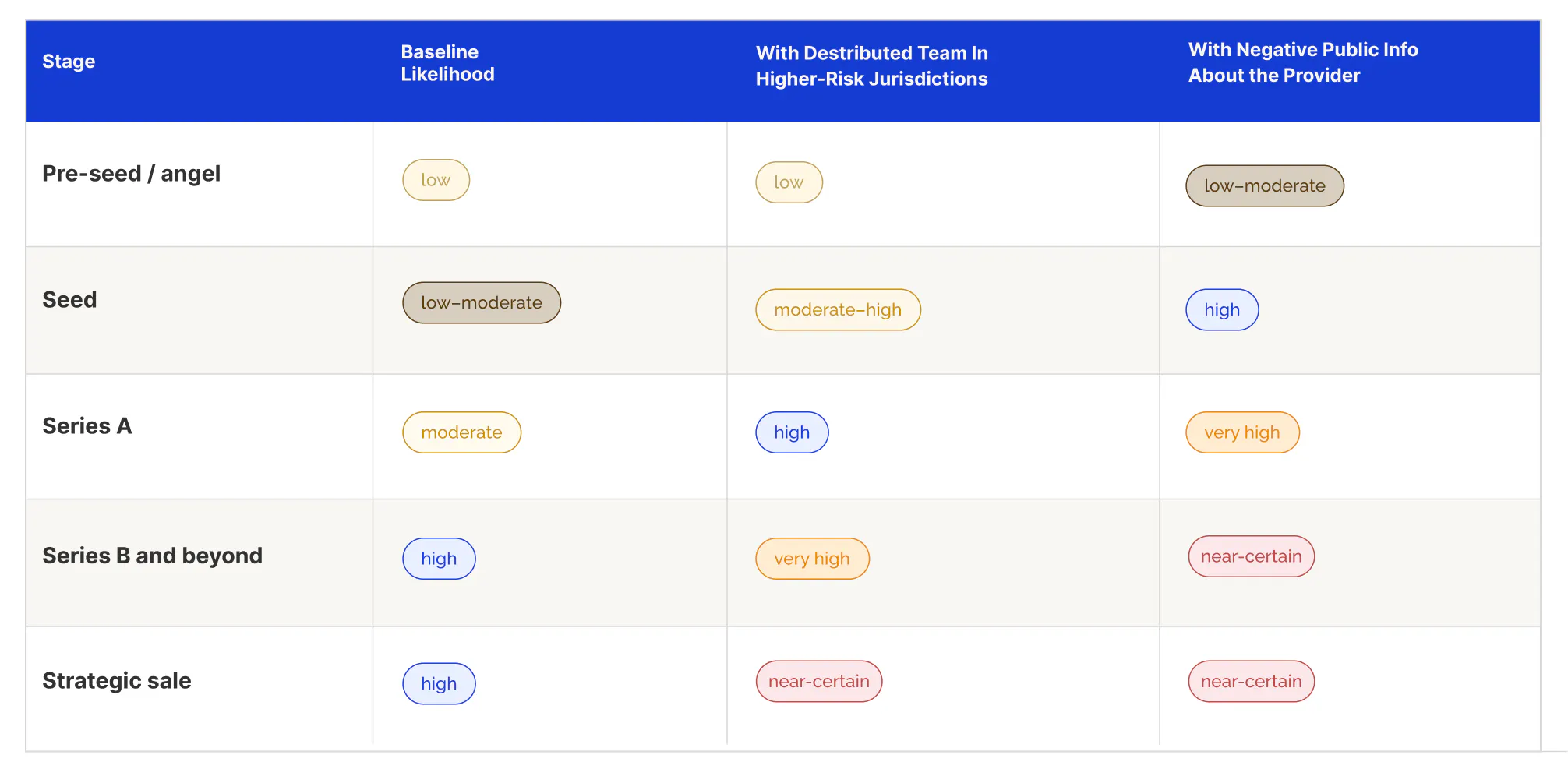
From this matrix, three practical conclusions follow for the founder.
The first concerns stage as an amplifier. At pre-seed, the question barely arises: capital flows into the idea and the founders, not into an operational layer that often does not yet exist, and diligence is essentially a sanity check. At seed, the baseline likelihood of deep due diligence is still low, but risk indicators — payments into higher-risk jurisdictions, negative press about the provider — raise it sharply. From Series A onward, scrutiny of payment infrastructure is an industry standard, and the matrix shows it is hard to avoid even with clean indicators.
The second concerns the planning horizon. If you are heading into Series A in twelve months and your business pays contractors in higher-risk jurisdictions, the likelihood of detection is already high. Given a retrospective window of 24–36 months, the decision to choose or change a provider is not made on the eve of the round. It is made considerably earlier. In practice, today.
The third concerns the inevitability of a strategic sale. In a sale to a strategic acquirer, deep due diligence is effectively unavoidable. If your company is performing well, you will reach that moment, and any accumulated provider problem will reach it with you. Cleaning it up under deal pressure, on a compressed timeline, is far more expensive than dealing with it in advance. Preparing for an IPO is a separate multi-year track run by specialist legal and audit teams, and it is outside the scope of this article.
One thing follows from all of this: the window in which changing providers is cheap is finite. The closer you get to your next round, the more expensive the proactive option becomes, and the fewer options you have left.
Personal liability of founders and directors
One consequence of the regulatory changes of 2024–2026 is rarely registered by founders: liability is shifting from the company onto specific people. Sanctions breaches used to be a predominantly corporate risk. Today they are a personal one as well. As noted above, the EU, UK, and US regimes all provide for the criminal liability of individuals, up to imprisonment.
There is also a separate category of risk that tends to be underestimated: the liability of directors and officers to shareholders and investors for failing to disclose material sanctions and regulatory risks. If, after a capital raise, it becomes clear that the company had a sanctions vulnerability or another material compliance problem, and that the leadership knew (or ought to have known) about it but did not surface it to the board or to investors, that is a basis for serious claims.
In situations like this, the question under review is no longer the sanctions issue alone but the quality of corporate governance: were investors informed of material risks in time and in full, were reasonable steps taken to assess and mitigate them, and did leadership act in good faith and in the company's interest.
Particularly sensitive are cases where an undisclosed or concealed risk later produces financial damage: frozen payments, bank de-risking, broken deals, fines, reputational harm, or a drop in company value. In several jurisdictions, exactly these circumstances have already given rise to claims against directors, with investors arguing that material risks were concealed, understated, or only partially disclosed. If a court or tribunal concludes that leadership failed to take reasonable steps to manage the risk or to communicate it in time, the matter can move beyond a corporate dispute and into personal liability for the losses the company suffered.
How to choose a reliable provider
If you are choosing a contractor payment provider for the first time, or reviewing the one you already work with, a handful of questions will tell you whether the choice is a safe one or whether it is going to become a problem.
First, ask whether the provider offers payouts into sanctioned banks or onto Russian bank cards at all, even in principle. If that capability exists, it is a clear sign of heightened risk, even if your own contractors have no intention of receiving funds that way.
Second, even if the provider currently states that it does not make payments into sanctioned banks and does not use sanctioned financial infrastructure, ask when it changed its internal policy and tightened its sanctions controls. As we wrote in our previous article, restrictions on most of the systemically important Russian banks have been in force not since the 19th EU sanctions package (adopted in late 2025), but since 2022. That means retroactive risk exists, and it cannot be erased after the fact.
Third, clarify the payment routing: which entity, and which bank, do you pay into, and which entity and which bank does the contractor receive funds from. The structures that actually make payouts to contractors must not themselves hold accounts at sanctioned banks.
If you are already working with a provider, there is an even simpler check: ask your contractors where and how they receive their money.
The answers to these questions will give you a clear picture: whether your current arrangement is sound, or whether it is time to change provider, immediately.
Conclusions
It all comes down to this: a contractor payment provider is no longer a technical detail of day-to-day operations. It is a structural decision, and one that materially affects your company's value, the outcome of your next round, and the personal exposure of your team.
The right time to act is not the week before signing a term sheet. It is now. Migrating to a reliable provider costs your team a modest amount of time. The cost of leaving the problem unresolved until due diligence finds it is in another order of magnitude entirely.
Sources
EU — criminal liability for sanctions violations Directive (EU) 2024/1226 of 24 April 2024, Official Journal of the European Union. https://eur-lex.europa.eu/eli/dir/2024/1226/oj
UK — strict-liability civil penalties Economic Crime (Transparency and Enforcement) Act 2022, amending s.146 of the Policing and Crime Act 2017. OFSI guidance: https://www.gov.uk/government/publications/monetary-penalties-for-breaches-of-financial-sanctions
US — extended statute of limitations and OFAC enforcement 21st Century Peace through Strength Act, Pub. L. 118-50, §3111 (24 April 2024); OFAC guidance of 22 July 2024. https://ofac.treasury.gov/media/933056/download
US — investment adviser oversight SEC Division of Examinations, 2026 Examination Priorities (17 November 2025). https://www.sec.gov/newsroom/press-releases/2025-132-sec-division-examinations-announces-2026-priorities FinCEN final rule postponing the Investment Adviser AML/CFT Rule to 1 January 2028. https://www.fincen.gov/news/news-releases/fincen-issues-final-rule-postpone-effective-date-investment-adviser-rule-2028
This article is analytical in nature and does not constitute legal advice. Founders facing specific situations should consult qualified sanctions counsel.